Is short-form history accurate?
Is TikTok history accurate, or is that the wrong question?
Most people asking this mean: can a 30-to-90-second video be true, or is the format itself a lie? The format is not the lie. A textbook chapter can invent a tidy cause. A five-minute app lesson can sand off a dispute and call the result fact-checked. A 90-second case can be careful. Length does not decide honesty. What you do with the contested parts does.
Short-form fails when it has to choose between a clean hook and a true one, and picks clean. Friday the 13th is unlucky because Philip IV arrested the Templars. Lustig sold the Eiffel Tower twice, full stop. De Molay cursed the king and both dropped dead. Those lines travel. Two of them are later stories. The third, the second sale, is a claim that varies by account. If the video cannot say that out loud, it is not teaching history. It is teaching a script.
Vellum is a 90-second product. We make it. The rest of this page is the method, not a sermon about other people's TikToks.
What does Paladin's "zero fiction" pitch actually mean?
Paladin: Learn History sells five-minute animated stories with a quiz after each one. The company's site says, "Every story is fact-checked by historians. Real events, real drama, zero fiction." That is a strong sentence. It is also the wrong promise for the material.
"Zero fiction" sounds like a firewall between story and novel. Fine, as a ban on making up meetings that never happened. History's real problem is not usually wholesale invention. It is the gap between sources. Two chronicles disagree. A confession was taken under torture. A biographer wrote fifty years later. A second sale of the Eiffel Tower appears in some Lustig retellings and is thinner in others. A stamp that says zero fiction hides that gap. A flag shows it.
Paladin still wins as an app. Quizzes, streaks, 4.6/5 from about 20,000 US App Store ratings, a product you can install today. I argued that at length in Vellum vs Paladin and in Apps like Paladin. The honesty fight is separate from the product fight. You can like their quizzes and still want the disputes on screen.
What is a fact-flag?
A fact-flag is an on-screen mark that this claim is contested, attributed, or later legend. Not a footnote you might open. A label in the shot, while the line is spoken. The point is that a person watching at 1x, on a phone, sees the fight without pausing to hunt a source list.
Take the Templars. Philip IV arrested them on 13 October 1307. That is a date. Jacques de Molay was burned in 1314. That is a date. "He cursed the king and pope, and both died within the year" is a later legend sitting on two real deaths. We tell the debt play. We flag the curse. The companion essay is How Philip IV erased the Knights Templar's debt; the short file is /case/templars-1307.
Take Lustig. He posed as a deputy from the ministry, gathered scrap dealers at the Hôtel de Crillon, and sold the tower as scrap to André Poisson. Poisson was too embarrassed to report it. Some accounts say Lustig came back and ran the same scheme again. Details of that second sale vary; we flag them. The file is /case/eiffel-tower-con.
The source note at the bottom of each case is the desk version of the same rule. If we cannot point to a source, it does not ship. If the sources disagree, the flag ships with the line.
Can a 90-second story still be true?
Yes, if you give up on covering "the history of X" and cover one play instead. Ninety seconds will not teach the Templar rule, the papal bulls, and the Portuguese afterlife. It will teach: a king erased a debt by erasing the bank, using heresy as the warrant. That is a true shape. The companion article and the case file hold the rest.
What 90 seconds cannot do is both sides of a live academic argument in full. We do not pretend otherwise. We name the model, flag the dispute, and send you to the case files if you want the longer arc. That is more honest than a five-minute lesson that sounds complete because the quiz has a right answer.
The success test is dinner, not a leaderboard. Can you retell the play without turning it into a myth? If the flag was on screen, you can say "the curse is legend" without killing the story. If the video needed the myth to land, it was not a history video. It was a campfire.
How should you check a short history clip?
Three questions. Does it name a date, a place, and a person you could look up? Does it mark the part that historians still fight over, or does it flatten that part into plot? Does it tell you who made the video? We disclose that we make Vellum. A lot of short-form history does not.
If a clip cannot survive those three, do not retell it. Retelling is the product. A wrong story told well becomes the version your table keeps. That is the actual risk of short-form, and it has nothing to do with the length of the file.
New cases drop daily on TikTok and Instagram. If you want the app version, with the same flags, the waitlist is at vellumstory.com. First 200 get three months free when it ships.
Quick answers
Is short-form history accurate?
It can be. Accuracy depends on how the maker handles contested claims, not on runtime. A 90-second case with on-screen fact-flags can be more honest than a longer lesson that hides the disputes.
Is TikTok history accurate?
Some of it is, most of it is a clean hook with the arguments sanded off. Check for a named date, a visible flag on the disputed part, and a byline. Skip the clip if it needs a legend to land.
How does Vellum fact-check short videos?
Every claim has to trace to a source. Contested claims get a fact-flag on screen and a source note on the case file. We do not use Paladin's "zero fiction" framing, because sources disagree.
Paladin markets itself with 'Every story is fact-checked by historians. Real events, real drama, zero fiction.' -> https://learnpaladin.com/
Paladin holds a 4.6 out of 5 rating from about 20,000 US App Store ratings (verified 2026-09-01) -> https://apps.apple.com/us/app/paladin-learn-history/id6511242367
Friday 13 October 1307 Templar arrests are historical; the Friday the 13th superstition link is a modern story, not a medieval tradition -> https://www.nationalgeographic.com/culture/article/160512-friday-13-knights-templar-superstition
Chinon Parchment (1308) records papal absolution of Templar leaders; Vox in excelso (1312) still suppressed the order -> https://en.wikipedia.org/wiki/Chinon_Parchment
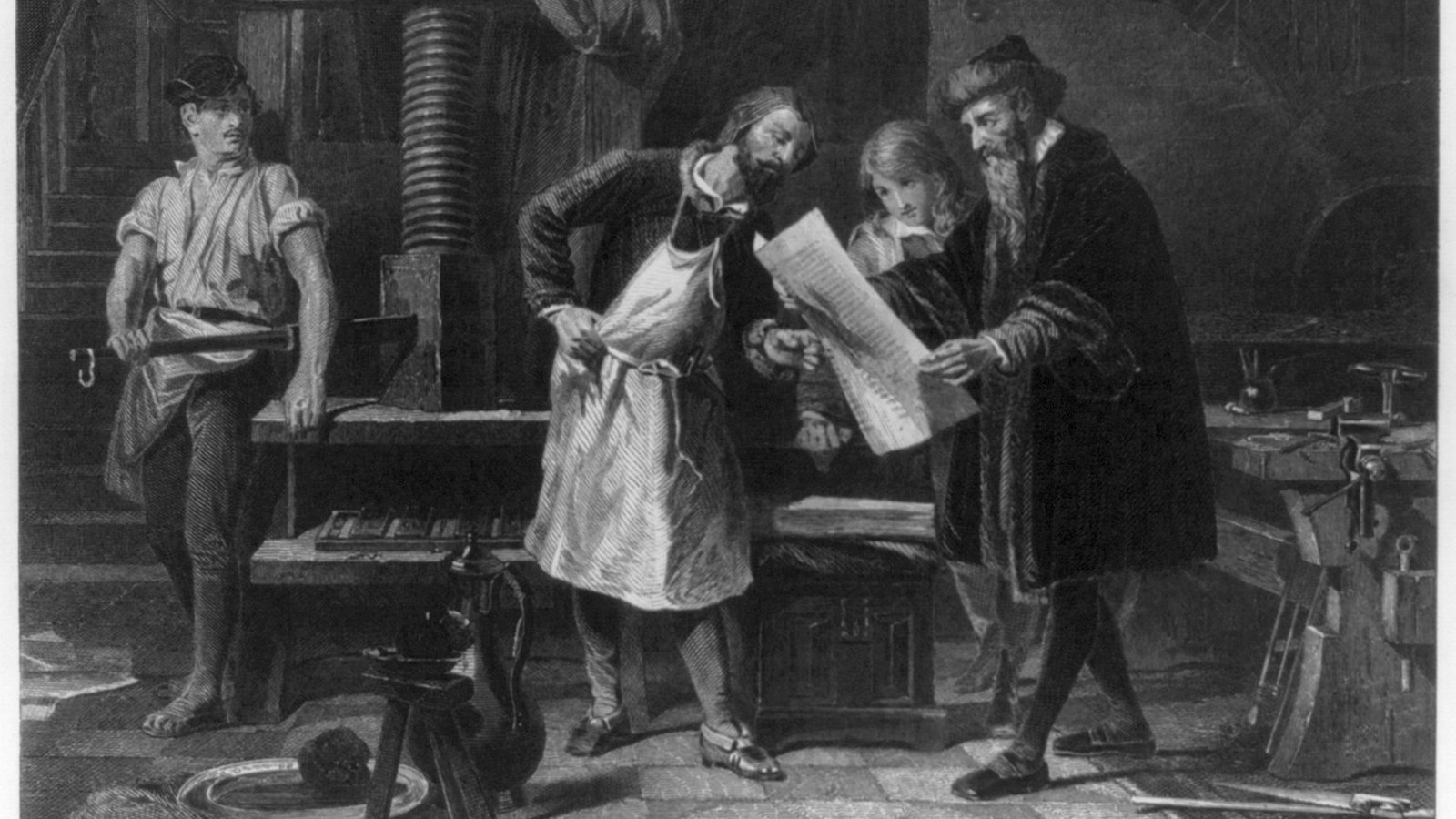
Cover image: Invention of printing - Gutenberg taking the first proof, steel engraving, Johnson, Fry & Co.; Library of Congress, no known restrictions -> https://commons.wikimedia.org/wiki/File:Invention_of_printing_-_Gutenberg_taking_the_first_proof_LCCN2006690328.jpg
New cases drop daily on TikTok and Instagram.
Tomorrow's case goes to the Founding 200.
Get the story you can retell