The Best History Apps in 2026 (Honestly Ranked)
What actually makes a history app good?
A good history app admits when historians disagree. Most treat history as a finished story, clean narrative, no seams, no argument. The apps worth using flag contested claims, disputed casualty counts, disputed motives, instead of presenting one version as settled fact.
Format matters more than most reviews admit. A 5-minute lesson works on a subway platform. A 45-minute lecture does not. You will pause it and never finish it. A podcast works on a commute or a run, but not while you are staring at a screen. Match the format to the moment you will actually open the app, not the moment you imagine opening it.
Free tiers tell you more than marketing pages do. Khan Academy's history course is free start to finish, so you can judge the teaching before committing anything. TimeTravelRome caps free users at 20 articles a day, generous enough to test the writing. A paywall that hits after one article usually means the company doesn't trust its own content.
Whether historians are actually involved matters too. Dan Snow built History Hit around working historians like Suzannah Lipscomb and Mary Beard. Tom Holland and Dominic Sandbrook host The Rest Is History as historians, not narrators reading someone else's script. That shows up in how an argument gets built, more than credentials on a landing page do. It also matters whether an app is history-specific, like Paladin or TimeTravelRome, or a general nonfiction platform where history shares shelf space with science and business, like The Great Courses Plus. The general platforms have more raw volume. The specialists go deeper on the one thing they cover.
1. Paladin: best for a 5-minute narrative history habit on your phone
Paladin builds each lesson around a single person or a single turning-point decision, then works forward and backward from there, cause leads to effect leads to the next cause. Lessons run about 5 minutes, short enough to finish one while waiting for coffee.
The app leans on streaks and challenges to keep you opening it daily, which will read as motivating or gimmicky depending on your tolerance for gamification. Pricing runs about $12.99 a month, with annual plans between $29.99 and $89.99 depending on region and promotions, and a free trial lets you test a handful of lessons first. The tradeoff is depth. Five minutes gets you a clear story, not the context around it.
2. The Great Courses Plus: best for real depth, if you have 30-60 minutes
The Great Courses Plus is built for people who want an actual lecture, not a summary of one. Individual courses run from 12 to 60-plus lectures, taught by university-level instructors, covering everything from the fall of Rome to the historiography of how historians build arguments. This is a weekend app, not a commute app.
You may know it as Wondrium. It launched as The Great Courses Plus, was renamed Wondrium in 2021, then reverted to The Great Courses Plus on June 4, 2024, so old reviews and search results show both names for the same product. The library holds more than 15,000 lectures, lessons, and documentaries across iOS, Android, Roku, and the web, at about $12.50 a month billed annually, with a 14-day free trial. The catch is time. A 45-minute lecture demands attention a 5-minute app never asks for, so this only works if you have a free evening to give it.
3. History Hit: best for documentary video from working historians
History Hit is what a documentary streaming service looks like when historians run it instead of a media company. Dan Snow founded it, and the app pairs original documentaries, new ones added weekly, with interviews from historians like Suzannah Lipscomb, Lucy Worsley, and Mary Beard.
The catalog runs past 1,000 programmes on demand, plus ad-free access to a network of eight history podcasts, with offline downloads for web, mobile, and TV. US App Store pricing (as of October 2026) is $7.99/month or $59.99/year — about two months free versus paying monthly. Regional storefronts can differ, so confirm at checkout if you are outside the US. If you want video from people who study the period for a living, on camera, this is the closest thing to it. Comparing documentary services? See apps like History Hit and apps like Curiosity Stream for MagellanTV, Nebula, PBS, and other options.
4. Khan Academy: best for a free, structured curriculum
Khan Academy costs nothing, full stop, and that changes what it is for. It is built primarily for students following a curriculum, not adults looking for entertainment, and it shows: the World History course was built with the OER Project specifically for classroom use.
Beyond World History, the app covers US History, Art History, Civics, and AP-level history courses, all through the same free iOS and Android app. There is no premium tier waiting to upsell you. The limitation is tone. These are built like classroom material, not story-driven content, so if you want the narrative pull of Paladin, you will not find it here. If you are a student, a teacher, or a parent who wants free and structured, install this one first.
5. Crash Course: best for free, fast overviews on YouTube
Crash Course is not an app. It is a YouTube channel, run by John and Hank Green through their company Complexly, free the same way a library card is free. Full World History and US History series exist, alongside 50-plus other courses across science and literature.
The channel has passed 17 million subscribers and 2.2 billion views as of March 2026, so the format has been tested against a real audience for over a decade. In February 2026, Complexly restructured as a 501(c)(3) nonprofit specifically to keep producing free, fact-based educational video. A nonprofit doesn't need ad revenue to keep the lights on, which matters for how long these videos stay free. The videos move fast, closer to a rapid survey than a deep read. Good for a quick overview, not much use if you want depth on one narrow event.
6. HistoryExtra: best for long-form magazine reading
HistoryExtra is a magazine you subscribe to for long articles, not a browsing app you open for five minutes. It was BBC History Magazine until January 2026, when it was renamed HistoryExtra and cut its official ties to the BBC brand.
A digital subscription runs $4.99 a month in the US for 13 issues a year, or £45.99 for 13 issues in the UK, covering the ad-free app plus full access to historyextra.com. This is closer to a magazine subscription than an app in the usual sense: no gamification, no streaks, no short-form video. If you like reading long features the way you would read a print magazine, this fits. If you want anything bite-sized, it does not.
7. The Rest Is History: best for a conversational deep-dive podcast
The Rest Is History is a podcast, not an app, hosted by Tom Holland and Dominic Sandbrook and produced by Goalhanger. It launched in November 2020 and the core show is free everywhere podcasts live: Spotify, Apple Podcasts, YouTube, Overcast, and the rest.
What you are paying for, if you pay at all, is The Rest Is History Club: weekly bonus episodes, ad-free listening, entire series released at once instead of week by week, a Discord server, and early access to live show tickets. Neither Goalhanger nor the hosts publish the club's price publicly, so budget for an unknown until you check the sign-up page. In January 2026, The Chernin Group took a minority stake in Goalhanger, worth knowing if you care whether a favorite independent podcast is staying independent. As a format, this is built for a run or a commute: two hosts arguing through an hour of narrative.
8. TimeTravelRome: best for travelers who want on-site historical context
TimeTravelRome is not general history. It is Roman Empire history specifically, built like a travel guide crossed with a reference library. The app covers more than 4,000 ancient sites across Europe, the Middle East, and North Africa, with 830,000 words of original content behind them.
It also has a gallery of 7,000 photos and a library of 300 ancient texts translated into English, a genuinely deep archive for a free app. It is not an AR app. That's a different, unrelated app called RARO, and mixing the two up is an easy mistake. The free tier caps you at 20 articles a day, enough to judge whether the writing is any good before paying for more. If you are planning a trip to Rome, Pompeii, or any Roman-era site, this is more useful in your pocket at the ruins than any general history app.
9. Vellum: best for short-form, true-story addicts
Yes, this is ours. We post a free 90-second true-story case every day, currently on TikTok as @vellumstory and Instagram as @vellum.story (see our best TikTok history channels roundup), styled closer to true crime than a textbook. When a claim in the story is contested among historians, we put a fact flag on screen instead of stating it as settled.
There is no app yet, and we are not going to pretend Vellum belongs next to The Great Courses Plus or History Hit on depth, because it doesn't. It's built for the opposite use case: a few seconds of scrolling turning into ninety seconds of an actual story, repeated daily. If that's the itch you're trying to scratch, and you want the app when it lands, join the waitlist at vellumstory.com. The first 200 people to join get a free year once it launches.
Quick answers
Is there a free history app worth using in 2026?
Yes. Khan Academy's history courses are entirely free with no paywall, TimeTravelRome's free tier allows 20 articles a day, and Crash Course is a free YouTube channel with full World History and US History series. Paladin and History Hit offer free trials but require payment after.
What's the best history app or podcast for a commute?
The Rest Is History podcast is built for exactly this: free on Spotify and Apple Podcasts, with two hosts talking through an hour-long episode. Paladin's 5-minute lessons also fit a short commute better than a 45-minute lecture from The Great Courses Plus.
What's the best history app for students versus adults?
Khan Academy is built specifically for students following a curriculum, with free World History, US History, Art History, Civics, and AP courses. Adults looking for entertainment rather than coursework tend to prefer Paladin's story format, History Hit's documentaries, or The Great Courses Plus for full lecture depth.
Paladin builds lessons around people and pivotal moments, ~5 minutes each, gamified with streaks/challenges -> https://www.educationalappstore.com/app/paladin-learn-history
Paladin pricing: ~$12.99/month, $29.99-$89.99/year depending on region/promo, free trial available -> https://play.google.com/store/apps/details?id=com.learnpaladin
The Great Courses Plus: 15,000+ lectures/lessons/documentaries, courses run 12-60+ lectures, apps on iOS/Android/Roku/web, ~$12.50/month billed annually, 14-day free trial -> https://kindlepreneur.com/wondrium-review/
The Great Courses Plus was rebranded Wondrium in 2021, reverted to The Great Courses Plus on June 4, 2024 -> https://twitter.com/Wondrium/status/1793311179558760760
History Hit founded by Dan Snow; documentaries plus interviews with Suzannah Lipscomb, Lucy Worsley, Mary Beard; 1,000+ programmes on demand, ad-free access to 8 history podcasts, offline downloads, web/mobile/TV -> https://apps.apple.com/gb/app/history-hit/id1303668247
History Hit US App Store: $7.99/month or $59.99/year (Oct 2026); regional storefronts may differ -> https://apps.apple.com/us/app/history-hit/id1303668247
Khan Academy is completely free with no paid tier, iOS/Android app -> https://www.khanacademy.org/downloads
Khan Academy free World History course built with the OER Project, plus US History, Art History, Civics, AP courses -> https://blog.khanacademy.org/free-world-history-course/
Crash Course is a free YouTube channel by John and Hank Green, produced by Complexly, not a dedicated app; 17M+ subscribers, 2.2 billion views as of March 2026, 50+ courses including World History and US History -> https://en.wikipedia.org/wiki/Crash_Course_(web_series)
Complexly restructured as a 501(c)(3) nonprofit in February 2026 -> https://en.wikipedia.org/wiki/Crash_Course_(web_series)
HistoryExtra was renamed from BBC History Magazine in January 2026, ending its official BBC branding relationship -> https://en.wikipedia.org/wiki/BBC_History
HistoryExtra digital subscription: $4.99/month in the US (13 issues/year) or £45.99 for 13 issues in the UK, ad-free app plus historyextra.com access -> https://www.buysubscriptions.com/magazine-subscriptions/history-magazine-subscriptions/bbc-history-magazine-subscription-us
The Rest Is History hosted by Tom Holland and Dominic Sandbrook, produced by Goalhanger, launched November 2020, free on major podcast platforms -> https://en.wikipedia.org/wiki/The_Rest_Is_History_(podcast)
The Rest Is History Club is a paid membership with bonus episodes, ad-free listening, full series drops, Discord, early ticket access; price not published -> https://en.wikipedia.org/wiki/The_Rest_Is_History_(podcast)
The Chernin Group took a minority stake in Goalhanger in January 2026 -> https://en.wikipedia.org/wiki/The_Rest_Is_History_(podcast)
TimeTravelRome is a free iOS/Android app about the Roman Empire covering 4,000+ ancient sites, 830,000 words of content, 7,000 photos, 300 ancient texts; free tier allows up to 20 articles/day; it is not an AR app (RARO is a separate, unrelated app) -> https://www.romeing.it/time-travel-rome-app-ancient-rome-in-your-pocket/
Vellum posts free daily 90-second fact-checked true-story cases on TikTok (@vellumstory) and Instagram (@vellum.story), with on-screen fact flags for contested claims; no app yet, waitlist at vellumstory.com with first 200 signups getting 3 months free -> Vellum brand facts, provided directly for this post (not web-sourced)
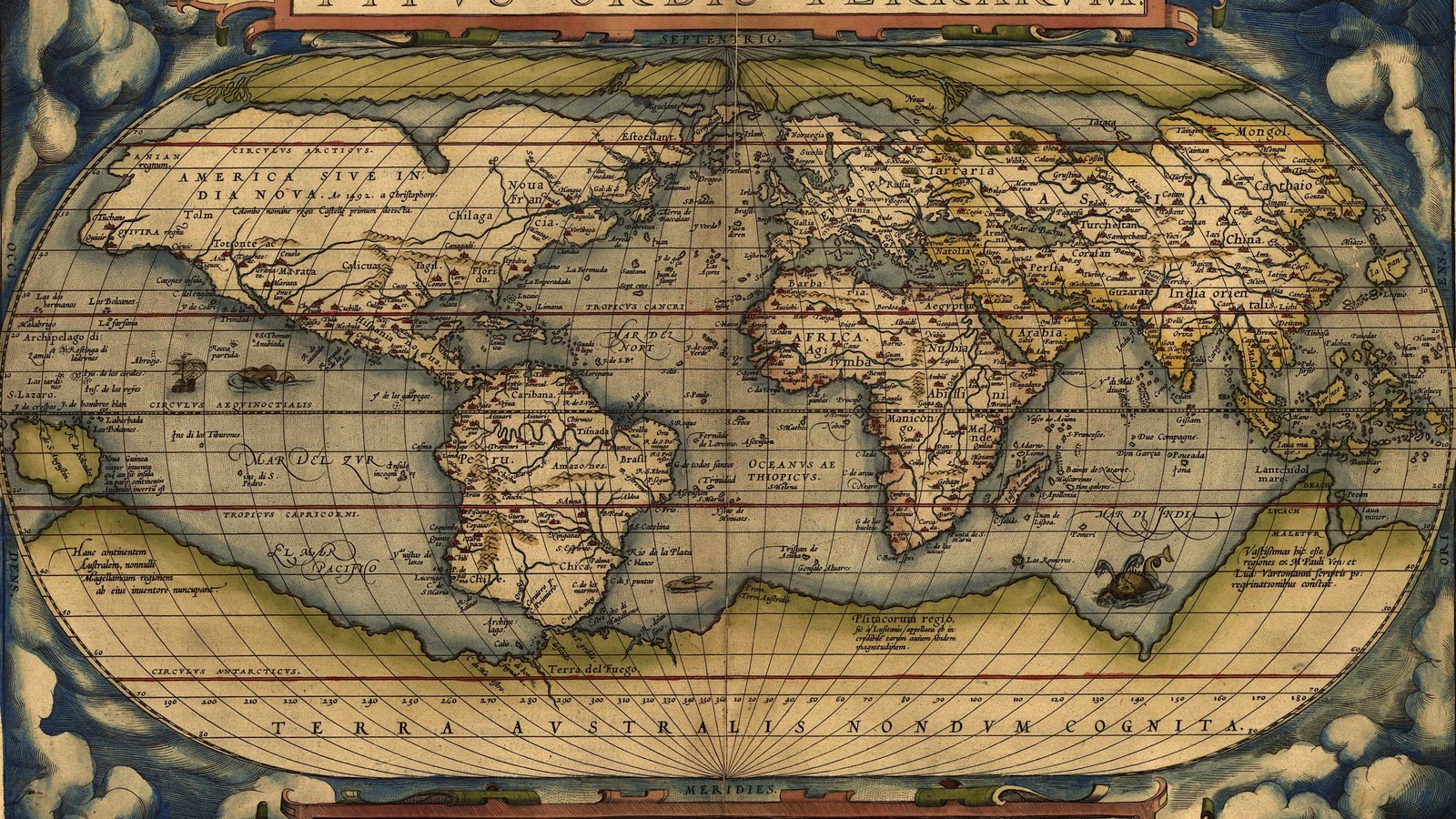
Cover image: Abraham Ortelius, Typus Orbis Terrarum, 1570, public domain -> https://commons.wikimedia.org/wiki/File:OrteliusWorldMap1570.jpg
New cases drop daily on TikTok and Instagram.
Tomorrow's case goes to Charter readers.
Get the story you can retell